Saturday, June 14, 2014

A Smorgasbord

Time for another smorgasbord post!  This promises to be the 'all-you-can-eat buffet of blog posts, too.

To wit:


A]  R & R

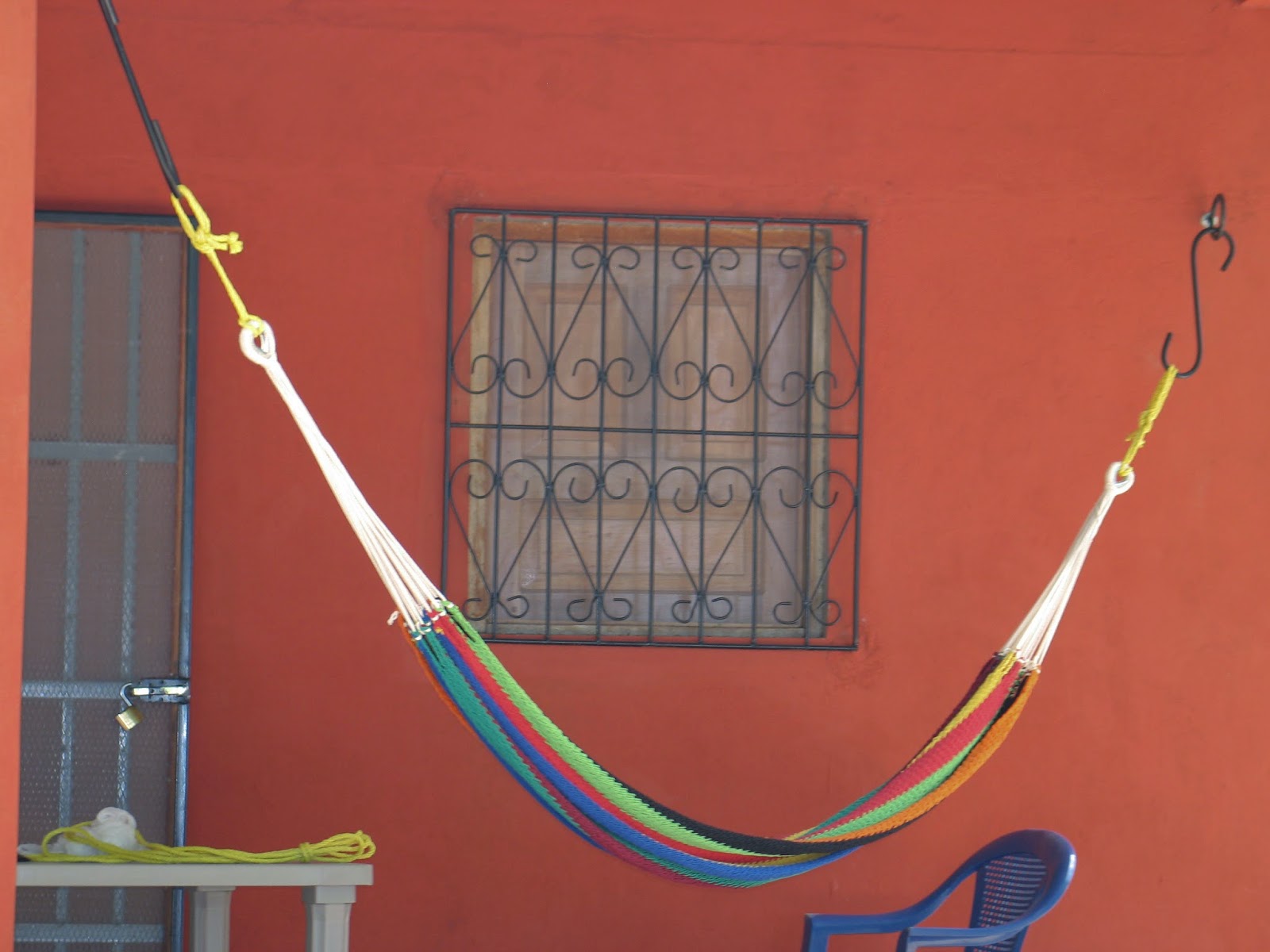
We got our hammocks installed, finally!  It took quite a lot of time and searching to find the hardware we needed.  As I've written before, our porch isn't set up to just tie off hammocks with rope.  We needed eye bolts, nuts and washers, as well as 'S' hooks for hanging them.  We had looked at every ferreteria (hardware store) we had encountered on the island and in Rivas, to no avail.  Finally, we turned this over to Pedro Pablo, our friend/taxi driver on the mainland.  He couldn't find them, either, but he did the next best thing - in fact, a better thing:  he had them made for us.  Beautiful, simple iron work, painted black and perfect for what we needed.

Shortly after returning home with the goods, Hamilton and his son came over and installed the hardware for us.  This required drilling through the concrete/cinderblock walls and posts on the porch.  Needless to say, they did great work and we thoroughly enjoy our hammock time whenever our busy schedule permits.


Hard at work?  Or hardly working?

Psst!  Guys!  Will you tell my wife that if I don't nap in the hammock at least one hour every day it will damage the hammock?

Relaxation Zone #1

Relaxation Zone #2

If the table on the porch is our office, this must be the break-room.
Chillaxin'

B]  Random iguana picture!


One of three that reside in a mango tree right near our porch
Another of the three.  Or the same one.  I can't tell.

C]  A Unique Problem 
(ring ring, ring ring, ring ri..)
"Good afternoon!  Thank you for calling Hewlett Packard customer service.  How may I help you?"
"Hi, I have an issue with one of your printers I'm hoping you can help me with."
"Okay, ma'am.  Can you please provide the model so I can pull up the manual?  Thank you."
"It's the Ink Advantage 2515, combination copier/printer/scanner."
"Ah, one of our most popular models.  What seems to be the problem with the 2515?"
"Well, um, it seems we have ants inside it."
"Excuse me, ma'am, did you say your aunt is using your printer?"
"No, no - we have ants that have gotten into our printer.  We're not sure how but you can see them through the glass under the lid."
"Okay, so your aunt put something in your printer.  Did she put it in through the paper feed or underneath where the printed documents feed out?"
"Uh, no.  Okay, let's back up.  Hmmm…  Ah, I got it.  You know how when you're on a picnic and you have the blanket all spread out and you open the potato salad and the fried chicken and the baked beans…"
"Oh, that sounds lovely, ma'am.  And the sun is shining and there's a nice gentle breeze blowing, right?  That's how a picnic should be."
"Well, er, yeah, okay - sunny, windy…"
"Yes, but not too windy!"
"Okay, not too windy.  So we have that pictured, right?"
"Oh, my!  Yes!  I'll have to plan a picnic with my Harold."
"You do that.  Okay, now, everything is perfect except all of a sudden you notice ants.  Everywhere!  Crawling on your blanket and heading for your food."
"Oh no!  Harold hates ants!"
"Yes, ants - the insects!  Perfect!  See, that is what we have inside our printer!  The bugs - ANTS!"
"Oh!  I see!  I think I can help you."
"Thank goodness!"
"First, let me ask a question to help me find the right solution for you."
"Yes, yes!  Anything."
"Why did you take your printer with you on a picnic?"

Oy.


D]  Random unusual lizard picture!

Came across this guy in the dark.  The headlamp caught something moving in front of us.  He was nice enough to hold still for the photo op.
Central American striped-back gecko, about 6" long
E]  Bounty!
Back home we did a lot of our shopping at farmer's markets.  We learned to enjoy certain foods seasonally, when they were available and learned to cook with very fresh, raw fruits, veggies, and meats.  In fact, Bex! wrote this post about our food experience thus far and how we've realized that when you see something fresh, buy it up because ya don't know when you'll see it again.  While this is still true, we've also noticed that when it's harvest season, there is plenty of everything, it seems!

Plátanos (plantains), mangos, huge aguacate (avocado), sandia (watermelon), piña (pineapple) all in abundance for a few months in March, April, May.  Our fridge was overloaded at times, which is a wonderful feeling.  Ah, food security!  


While we purchase a lot of food from local vendors, we were blessed by the locals many many times with gifts of produce.  There were many nights when we would come back from teaching classes, loaded down with produce gifted to us by our friends.  Several times, one of us would be walking home in the dark and hear 'Profesor!  Profesor!', to find a friend who had been waiting for us to pass through the village (like we do each evening) so they could hand us a bag full of fruits and vegetables.


The people are so kind and gracious.  Speaking of…


F]  Fish on!

One family in particular has been exceptionally gracious to us - the Lorio's.  We teach an evening class at their house three days a week, the session attended by Luis and his daughters as well as all the neighbor kids.  It's a fun crew and the setting couldn't be more spectacular.  Luis and his wife, Rosabella, have given us more produce than we can remember!  One day, we got a special and unique visit at the house.

Luis wears many hats, as do a lot of people here.  He works several jobs, taking it as it comes.  One thing he does, and very well, is fishes.  We see him all the time out in his hand made boat with his boys and/or friends, dropping their nets and hauling them in.  One afternoon, we were sitting on our porch working on lessons and Luis rowed by in his dugout canoe.  He waved and called to us, then started making his way to shore.  So I waded out to meet him.  He opened up a large burlap bag that was full of fish!  He presented me with two large, still alive tilapia he had just caught!  Wow!   


I cleaned them and we had them for dinner that night.  I cooked them Nica style - slit the sides and dusted them with seasoned flour, squeezed naranja agria (sour orange) over them and inserted slices into the cavity, then fried them in a little oil turning them once.  They were flaky and juicy and wonderful!


G]  Random gecko picture!


Bad skin day.  "I like the color but do you maybe have something in a larger size?"
H]  Another food story
The lakeshore in front of our house is lined with huge mango trees.  There are a few other trees, as well.  One in particular caught our attention a) because it's directly in front of our porch between us and the lake, providing nice shade as the sweltering sun goes down directly west of us and b) we noticed it had a small green round fruit on it.  Curious, we asked one of our friends what this fruit was and he told us it was an olive tree!  Who knew!  We tasted some and they were a mix of sweet and grape-like with the kind of bitter that sucks all the moisture out of your mouth.

Some quick research on the innerwebs suggested brining them, so we harvested a bunch of olives, slit them on one side and stuffed them into a jar.  We let them sit in the fridge for a few weeks, taste testing periodically.  Sad to say that the original bitterness never improved, so the experiment was a failure.  The tree is done fruiting for now but if it comes round again, we'll probably try a different approach with a different brine.  We'll keep you posted!


Hand harvesting without a ladder.
They started falling off in good number when they turned black, so we decided black meant ripe.
I]  Random horses at sunset picture!


Yeah, I was playing with Lightroom...
J]  Visitors from Alaska
In the 'it's a small world' category, Bex! received word from her folks back home in Juneau that some family friends of theirs were coming to Nicaragua and would be visiting Ometepe!  And not just the island, but they were actually going to be in our village - Merida!  We walked up the hill to La Omaja and had dinner with Claire and her family.  It was a great evening and fun to listen to Bex! enjoy some conversation with friends from her home town.  Plus they bought us volunteer English teachers dinner, which was very kind of them. 

K]  Clase de francés

Way back in February, we had four awesome volunteers from Switzerland.  Two of them, Chris and Théo, taught a French class for some of the intermediate adult English students while they were here.  I even took the class when time permitted.  After they left, Bex! decided to carry on the torch.  She found a great resource online, planned her lessons and now teaches a class one evening a week at our house.  After an initial interest, attendance as been sparse, so this one is on life support.  We'll see how it goes.  In the meantime, it's fun!

Muzzy!


Wait, that's Spanish.  Uh, French, French.  Hmmm.

L]  Speaking of France
We met an absolutely wonderful couple from the Burgundy region of France, who live in a small town near Dijon.  They were traveling through Nicaragua and stayed several days at Hacienda Merida.  How we met them is a bit of a story.  We were at home and Ericks stopped by.  He's one of our high school students and the son of one of our friends, Nora.  He told us that Nora needed Bex! to come to the hacienda right away to help translate for a French couple that had some sort of emergency.  No problem - we locked up and hustled over there to see how we could help.  And by 'we' I mean Bex!, the French speaker.

When we arrived we were introduced to Dominique and Bernadette.  We instantly liked the couple very much and the feeling seemed mutual.  My official role was to keep the table in beer while the French speakers conversed.  The emergency was this:  Dominique and Bernadette had gone kayaking out to Monkey Island.  The hacienda has kayaks available for guests, so they grabbed one and went out on the lake.  Unfortunately, the kayak they took out was defective and was taking on water, unbeknownst to the paddlers.  They got out a fair ways and the craft floundered, dumping them in the lake.  During this, one of Dominique's crutches sank to the bottom.  Dominique has a health issue which requires him to use crutches to get around.  


This near tragedy was completely avoidable, of course, had there been a program in place to check and maintain the kayaks on a regular basis.  There is none that we're aware of.  This particular kayak was checked out after the accident and found to have a separation along one of the seams.  Be that as it may, the issue now was the missing crutch.  Some of the staff went out and searched for it, diving down and scouring the lakebed.  No luck.  The only possible location a replacement would be found is in Managua.  Rather than screw up the rest of their trip, they hired Kevin, an employee of the hacienda, to travel to Managua to pick up a new crutch. This is where Bex! came in.  She translated from French to Spanish so that Kevin understood exactly what to look for.  And the next day he went and was successful.


We so enjoyed visiting with Bernadette and Dominique that we invited them over the next day for lunch.  We gave them directions and they showed up right on time.  We enjoyed fresh pineapple and iced tea.  Then Bex! made 'gallopinto Americana', her spin on the traditional Nica dish.  Served with huevos revueltos (scrambled eggs) we had a leisurely meal and a wonderful visit.


Now, you might be thinking - how did I fit in with this group, our guests speaking only French, along with my wife.  First of all, I'm naturally charming, so get along with people in any language.  Secondly, I can pick up enough words to keep pace of the conversation, asking the wife an occasional question to clarify what was being discussed.  But mostly I cleaned up and did dishes while the three of them visited.  Stick to our strengths, right?

The next evening, we were all invited to Nora's house for dinner.  If you recall, we had dinner at Nora's one time before when her brother was visiting from Italy.  This time we again enjoyed a wonderful Nica dinner and more good conversation, with my amazing wife translating back and forth between Spanish and French.  It was a lot of fun and very gracious of Nora to have us over.  I think she felt bad for what happened to Dominique and Bernadette.


(l-r) Lionel (Nora's father), Bex!, Bernadette, Dominique, Nora, moi
Funny thing is that neither of them had anything bad to say about anything.  To them it was part of their adventure and 'things happen'.  They shrugged it off and enjoyed their entire stay in Merida.  In fact, after leaving Merida they took the overnight ferry to San Carlos and down the Rio San Juan to El Castillo, which is quite an adventure in itself!

We've made a lot of friends down here and now have a standing invitation to visit Bernadette and Dominique at their home in France, which we will likely do at some point in the near-ish future.  It is in Burgundy, after all.


M]  Random giant flower picture!


N]  Jam session
Bex! was walking home one evening after teaching classes at the hotel.  As she walked by 'Fruitlandia', the small produce stand run by Doña Clara and her family, she heard wonderful music being played.  She stopped and looked around, then heard 'Profesora!', so she walked behind the stand and found Jehu and Chema playing mariachi and Nica music.  Jehu is Clara's husband; they are the parents of Edar, one of our high school students.  Chema is Maykel's dad, where we helped butcher the pig.  She stayed to listen to a couple of songs, then came home.  

As it turned out, their impromptu 'audition' would come into play in the near future.  


Oooh, foreshadowing.


O]  Random chicken in the classroom picture!


P]  A magical Friday afternoon
We have so many special moments throughout each and every day, it's hard to remember them all.  One of our young students running up to give hugs, an adult student conversing with us in their newly learned English, the wave from a friend who sees us walking through the village.  All very amazing stuff.  But one Friday was extra special.

It started out with a most excellent first grade class session at Ometepe Bilingual School.  The kids were great - energetic, focused, into what we were doing.  It was a tremendous class!


As is our Friday routine, after class we took the shortcut up to Margarita's for celebratory beers.  We were hanging out enjoying an ice cold Toña when some of our first graders showed up.  It's not unusual, of course, for kids to be here.  It's an open-air bar run out of Tia Margarita's home and many of the children are related to her in some way.  We had fun playing with them, getting a little extra time outside the classroom.


First grader Dayana took this pic with my camera; me & Jasmina
Jasmina, Profesora Rebecca, Dayana and Jesner
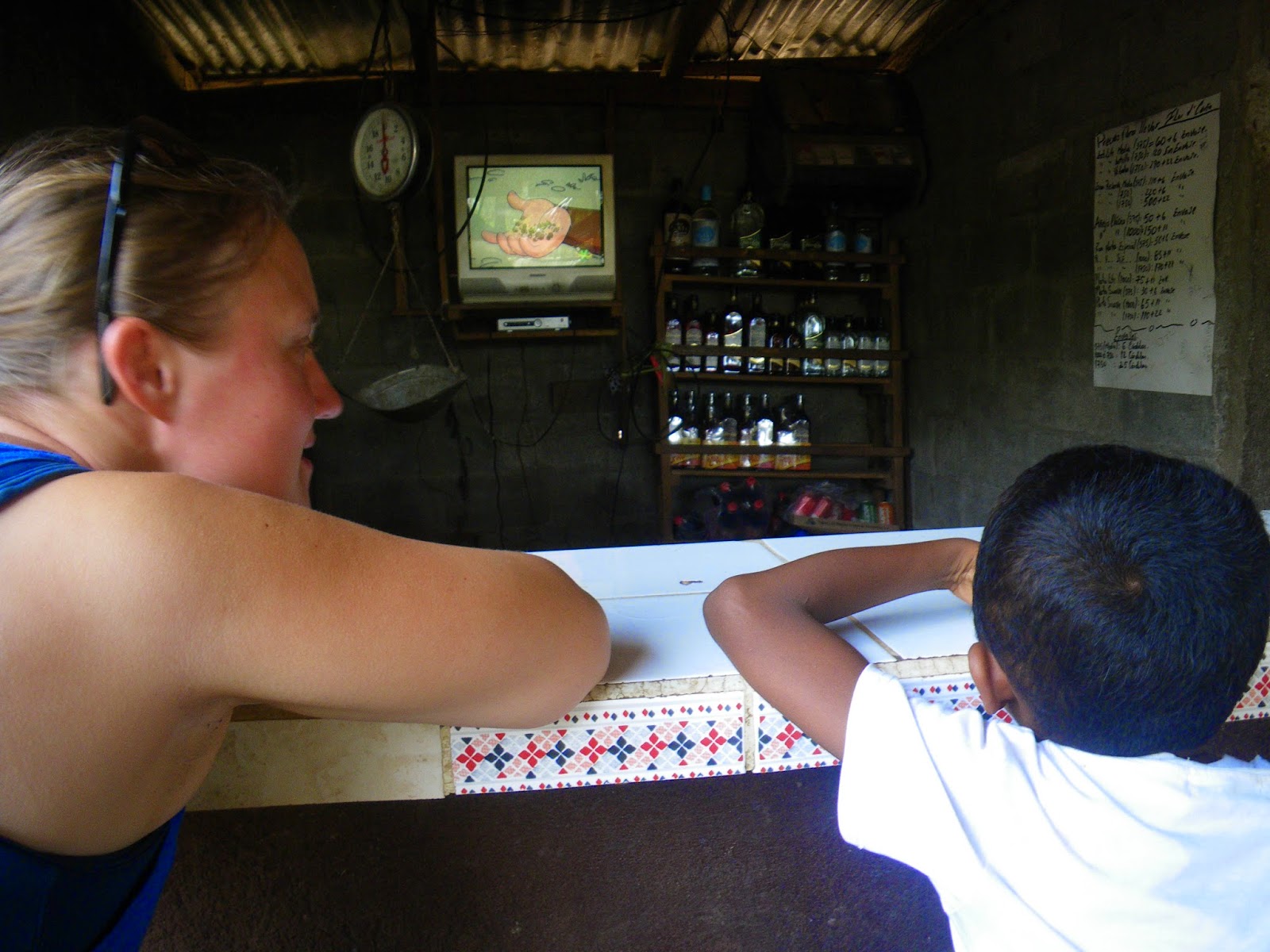
One of the funniest moments is shown below.  Jesner sat at the bar and watched cartoons with his teacher!  Haha!  You'd never see this in the states!


Jesner is watching Curious George; Bex! is watching the Flor de Caña
After a short time, Bex! came back to the table and was replaced - by two more first graders!


After a hard day of learning ABC's and playing tag, a kid's just gotta unwind
A peek into the kitchen revealed that Tia Margarita and her staff were making nacatamales!!  They had actually already assembled them and were now tying them off which, coincidentally, we learned how to do just the week before.  So we jumped in to help, and we learned a new tying technique that is easy and more secure than the way we knew.  So, that was good!  Tia and her help were so tickled that we were there, they sat back and let us tie them all up!  Haha!  it was hilarious, really.  They couldn't stop giggling as we successfully knocked out all the tying.

Because we love nacatamales, we asked if we could buy some.  Tia was more than happy to hook us up.  If you remember from a couple of posts back, nacatamales have to cook for ~3 hours or so.  No worries.  She had someone deliver them to our house!  Maybe soon we'll be able to call for a pizza.


Our extra-cool day wasn't over yet, though.  We went home and hit the lake for a swim.  The kids enjoy it when they see us anywhere in the village and today a handful of them were swimming near our house.  As soon as they saw us, they swam right over to join us!  Two of the young girls, Genessy and Gemela (not students but we know them), wanted to learn some English, so we did colors and numbers and basic nouns, all while splashing around in a tropical lake!  A pretty surreal day!


And we had nacatamales delivered to our door and enjoyed them for dinner that very evening.


Yep - magical. 


Q]  Random impromptu English class at a bar picture!


Bex! with a very happy Juriel who learned how to form questions and yes/no answers

R]  More on nacatamales
Another Friday afternoon, more end-of-week brewskis at Margarita's.  This time we overheard Tia asking some guy to make sure he brought the banana leaves the next morning.  Banana leaves mean only one thing:  nacatamale deliciousness.  Hearing this, our ears perked up and we immediately asked Tia if we could again buy some.  Of course, she said yes and again she had them delivered to us.  Now we are on the home delivery system, the Domino's of Merida!  Tia Margarita makes nacatamales almost every weekend.  If we don't happen to stop in for a beer and place our order, she sends someone to the house to find out how many we want!  How cool is that!?

S]  Teaching the beer guys

The Toña truck makes deliveries most every Monday and Friday.  We've run into the crew several times at Margarita's.  We talk beer and think it's pretty cool that we both worked at a brewery in the states.  In getting to know them, they expressed a desire to learn English.  They live in Moyogalpa, where the ferry comes in.  They asked the same question everyone else from there asks us: Can you come to Moyogalpa and teach.  We were surprised to learn that there isn't anyone there teaching English.  It's one of the two 'big' towns on the island and the main port.  Tourism has been on the rise in the last few years, so this opportunity is perfect for someone.  But, as we always have to answer, we're committed to Merida for the year.

We have sat with them and covered some basics, and even given them some worksheets to do as well as lists of vocabulary, words in English with Spanish translations that will hopefully help them out.  When we do run into them, there is almost always some teaching, even if it's just 10 minutes or so.  They have questions and we do our best to help them out.


T]  Random chicken in the yard picture!


Stop waking me up at 4:30 in the morning!!!


*****     *****     *****     *****

I think that's it for now!  Tata!


*****     *****     *****     *****


Oh, wait a sec…


U]  Random 2,000 lb. bull in the path that will probably make us late for class picture!


"You'll get to class when I say you get to class."

Thursday, June 12, 2014

Cultural Differences

We teach an early morning class three days a week, right on our front porch.  It's not a huge group but the students are eager and happy that we're willing to get up early to do this.  Hell, we're here to teach and we've shown the community that we'll hold a class if students will commit.  It's a fun group, all women.  We have a good time with this boisterous class!


Our initial survey said no one would come to a morning class...
All respondents were men.  We've learned a good lesson about sampling.
This morning, about halfway through the lesson, one of my students (Mayerly) pointed up over my head and her eyes got big.  Now, if you've read the blog you'll know we've had our share of encounters with creepy crawlie things.  So, yeah - I cringed a little.  Then Krisna said 'Congo!' which means 'mono' which means 'monkey'.  Sure enough, in a small scraggly tree near the porch, up about 15 feet off the ground on a thin wobbly branch, sat Zira and Milo.

We have howler monkeys in the trees around our place.  We hear them regularly and see them pretty often, too.  The three that visit the most often are a family - dad, mom and baby.  In honor of 'Planet of the Apes' (the original, not the crappy remake) we named them Cornelius, Zira and Milo.


Monkeys on the move.  (Not pictured: Cornelius.)
We've seen the family on the ground only twice before.  They usually move around branch to branch, through the huge trees that are all over the village.  There are too many predators on the ground, these being mostly packs of dogs, so the monkeys stay up as much as possible.  


Zira and Milo!  I was not this close!  This is a enlarged zoom of the previous picture.  Look at those adorable monkey faces.


A Cornelius Cameo.  (Again, an enlarged zoom to show his face.)
After class wrapped up and our students went home, we enjoyed our morning beverages on the porch, tea for Bex! and coffee for me.  We watched as Zira and Milo slowly got comfortable enough to come down lower .  The tree they were in is isolated and to get to the big trees nearby would require a dash across open ground to the tree where Cornelius was waiting for them.  It was very stressful for them and amazing for us to watch this family drama unfold.  How Zira and the little one ended up in this tree, we don't know.  She must have gone up in the night, then felt stuck there when the sun came up and humans started holding an English class not twenty feet away.

Come to think of it, maybe THIS is how 'Planet of the Apes' gets started, with monkeys eavesdropping on English classes!!  Holy crap!!  We apologize in advance for the downfall of mankind.  But I digress…


Zira made her way down to the lower branches, keeping a very close eye on us. Cute little Milo climbed down most of the way on his own, then hopped on mom's back.  Zira hit the ground, looked around to make sure it was safe and took off for the nearest tree that allowed her access to her waiting hubby.  Once they were reunited, you could hear them grunting and howling.  It was a wonderful sight, a wonderful sound to witness.


Monkey noises!  Go to the May 16th post and scroll to the bottom for audio of our very own monkeys recorded last month by Mike Sakarias, Bex's dad.


All's well that ends well, right?  Right.  


Not so fast, unfortunately.


Nicaragua has produced some fine baseball players many who have made it to the big leagues in the states.  We joke that the reason they are so good is because of mangos.  Not because of the nutritional attributes of this common fruit, although they are very good for you.  It's the harvest method that we believe makes a great ball player.  The locals throw rocks.  Lots of rocks.  The mango trees here have large trunks with no lower branches, so they are very difficult to climb.  So people huck rocks up into the branches and hope to knock some fruit loose.  Mangos are pretty tough and no worse for wear after hitting the ground, so it's all good.


A couple of hours after class, there was a group of two young men walking down the path along the lake in front of our house, throwing rocks and collecting mangos.  We heard the howlers making noise, which is normal.  They were giving a warning and we watched the mango hunters make their way down the trail.  Bex! went inside to do some work and I was out on the porch.


A little while later, though, I saw the two guys hurrying back toward their family members, who were harvesting coconuts nearby.  The kids were collecting coconuts and the women were splitting them open and scraping the meat out.  This was all maybe 40 meters away, within sight of our porch.


As the guys hustled by our place, I noticed they had something wrapped up in an orange t-shirt.


I had the monocular with me on the porch as I worked on lesson plans.  So I got it out, held it up and focused it.  They had Milo!!


Hence, the title of this blog post.


I told Bex! that they had monkeynapped the baby.  Unsure what to do or how to handle this but damn positive we weren't going to just sit there, we moved our stuff inside, locked up the screen door and walked over to chat with our neighbors.

Bex! speaks good Spanish but doesn't have the vocabulary like 'stressed' and 'kidnapped' and 'how would you like it if someone came and snatched your child away'.  The two guys were kinda laughing at us, like 'it's just a monkey, no big deal'.  One guy was petting it and tried to feed it a mango.  But Milo was scared to death, you could tell.  He was shaking and kept trying to get away and run to a tree, just like Mom and Dad had shown him.  He got loose one time but was just too unsure which way to go and the guy with the t-shirt soon had him covered and captured again.


We kept pleading our - and Milo's - case.  The guys were okay and seemed understanding.  But one of the women started in on us with "In our community, there are a lot of monkeys. We do this all the time.  They are pets.  Why are you so upset?"  She was a little pissy with us, of course.  And maybe she had a right to be.  We're outsiders here.  But we couldn't let them take Milo and break up this little family unit we've come to know and love.


The guys relented, and we walked back toward out house.  They took the path back toward where Cornelius and Zira were earlier and we went through the gate to our place.  Bex! went back inside, visibly upset.  I think she was vacillating between anger and frustration, between tears and getting in a fight!  This is why I love her.


The guys came back a couple of minutes later, called to me and told me it was all good.  They had let Milo go.  I thanked them and walked over to see if I could spot the little family.  Nope.  Of course, I wouldn't have stuck around, either!


A few thoughts from Bex!:

It was a whole mix of emotions this morning and throughout the day - fear, frustration, sadness, anger, adrenaline, uncertainty, worry, doubt, inadequacy, wistful(ness), selfishness.

Fear for this monkey family we feel we've gotten to know; that the toll of today's stress will shake their fragile survival balance.  We've taken to feeling protective of our monkeys (and our iguanas) and even just this morning shooed off a stray dog that was touring the yard as mom and baby were moving down the tree.

Frustration that we couldn't communicate with the locals today and that there is such a gap in our norms for human-wildlife interaction.  

Sadness for our monkey friends who had to go through the experience today, particularly in contrast to the quiet morning scenes of napping, eating, and reuniting that we had just observed.

Anger that someone would do this to these beautiful, peaceful monkeys.  And that someone would ruin my day in this way.   (Even though this is unfounded - in that I did not get the impression these people were trying to hurt the monkeys or upset us.)

Adrenaline because it's not every day you go confront six strangers, a machete, and a baby monkey while you're a gazillion miles from home.

Uncertainty because I don't know if these people are the angry sort, or are just shrugging about the crazy gringos who anthropomorphize monkeys.

Doubt over whether we made a mistake talking to them; over whether it would have been possible to avoid the incident if I'd been more suspicious when they were hooting at the monkeys.  (I was initially somewhat suspicious because I heard a dog barking, too.  But ultimately I reminded myself that we also have fun hooting with howler monkeys sometimes and went about my business.)

Worry about whether we have made enemies or permanently pissed off or alienated some neighbors.

Inadequacy because my mangled explanations of "it's bad for the monkey" are a pretty lousy version of the education that's needed to teach people about how to interact with wildlife without causing harm and about why they should want to do that.  

Wistful for our illusion of a wildlife sanctuary.  We've enjoyed a lot of iguana and monkey action in the yard over the last two weeks.  We've always been a bit aware of how vulnerable these creatures are - chasing off stray dogs, looking around when the monkeys howl to see if anything bad is happening, telling our friends "nos iguanas no son para comer," encouraging the iguana to stop munching grass out there in the open and get back to the tree where it's safe!  But I was also somewhat lulled into a sense of security and wonder with our porch-based daily wildlife sightings.

Selfishness in being bummed that we may never get to see "our" monkeys again - because if this happened to me I'd move on without looking back and would stay the f*&@ away from humans.  We'd like to see Milo's family again to know that they are all okay, but that may never happen.


Back to Dave:

Although we didn't see them reunited, I sincerely think they were.  And here's why:

When the guys were making their way down the path, Cornelius and Zira were making all kinds of noise.  Like I said, this is normal.  Thinking back as I'm writing about the whole episode today, I realize that the monkeys suddenly stopped howling.  Lots of noise; suddenly, no noise.  A minute later, the two guys came cruising by with Milo.  I think the parents were calling out their warning grunts and howls, then got quiet because their baby had just been taken.  

But very shortly after the guys let Milo go, I heard Dad and Mom again, howling and grunting.  So, yeah, together.  I think they got their little one back and were quite happy about it.

We hope we see Cornelius, Zira and Milo again but won't be surprised if we don't.  It was a little weird intervening in something like this.  We know we're just visiting and that this culture is incredibly different than ours.  We hope we did the right thing and that we didn't make any enemies. 

I think we did.  Time will tell.

Friday, June 6, 2014

One Man's Trash … Is Another Man's Treasure?

Mini-post time.  By Bex!  To tide you over while we (David) work (works) on the next big post.

Today's post is brought to you by the letter T.  T is for trash.  Has this question been keeping you up at night: What do Bex! and Dave do with their trash on Ometepe?  Well, tonight you can sleep because the answer is coming up, right after these words from our sponsors.


"Toña - bringing Eastern gear to Nicaragua since 2013"
"When your nacatamale needs pep or your huevos revueltos need zip, turn to…         Lizano Chile"
"Nothing cleans up delicious pork grease like Axion soap"

Thank you sponsors.  We now return to your program already in progress.

We have four waste streams at our casita.


1.  Compostable


If it's organic, we toss it in the compost.  This is all our food scraps - watermelon rinds, mango pits, coconuts with the agua de coco sucked out, tomato stems, orange peels, carrot tops, banana leaves from nacatamales, pineapple rinds, chicken bones, etc.


Our compost pile isn't much to look at.  That's because we also call it our 'jungle animal feeding zone'.  After the dogs, chickens, pigs, iguanas, magpie jays, grackles, vultures, spiders, and ants have a go, there's pretty much nothing left to actually decay.  And if by some chance there is anything remaining, the warm and humid climate makes quick work of breaking it down.

2.  Burnable

If it's paper waste, we burn it.  This is cereal boxes, used printer paper, etc.  This is also all TP.  Yeah, it's gross, but Central American plumbing and water pressure lack the strength and oomph to handle TP.  It goes in a little trash can in the bathroom and is burned regularly.


3. Fit-In-A-Two-Liter-Bottle-Able

If it's not organic and non-burnable, we next check if it's small enough or flexible enough to fit through the mouth of a two-liter bottle - say a coke bottle or a water bottle.  This is all plastic packaging and bags, batteries, dead white board pens, plastic straws, etc.  If it fits, we stuff it into a bottle, packing it in until we just can't fit another shred of plastic in.  


We only fill one of these every 3-4 weeks.
Then we cap off the bottle and bring it to Hacienda Merida.  They use these two-liter bottles in construction of outside tables and chairs and of the school buildings.  This approach captures the waste and keeps it out of the environment, plus reduces the amount of cement needed.  For more on this cool solution to the waste problem, check out these YouTube videos about the Sustainable Table and about the Garbage Palace School.  Or read about constructing the first school building here.

4.  Our Own Personal Landfill

If our trash doesn't fit into categories 1, 2, or 3, we're out of options.  This trash gets placed in our own personal landfill, an area out back where we toss whatever's left over.  This includes glass and plastic bottles (sans lids, since we have a re-use program for those), tetra-pack cartons from orange juice and chocolate milk, empty printer cartridges, beer cans, and other miscellany.


There is no opportunity for recycling in Merida.  However, reuse is actively practiced.  We use old glass jars to keep homemade vinaigrette; we collect clean bottle caps for sorting activities with the kids; we print or write on both sides of our printer paper before burning it; we buy local honey packaged into 12oz soda bottles; we made a hummingbird feeder from an old Coke bottle and an old Axion tub; we use the box our fan came in as a printer stand.


I love these!  They are like Nicaraguan Legos.  If I ever stop playing with them, we'll take them to class.

Here, hummingbird!  Come here, little buddy.
One good thing we experience in Merida is that there isn't as much packaging.  Many items are sold as eaches - e.g. eggs and pencil sharpeners.  And other things can be bought in bulk - rice, sugar, flour, beans, etc.  So, instead of coming in their own wasteful individual packaging, the store buys them in bulk and sells them to us as is, with maybe a plastic bag (which we can easily squish in a 2-liter bottle after we've reused it a couple times).

One bad thing we've experience in Merida is the trash left behind when "well meaning folks" come.  Twice now, we've experienced this phenomenon.  In November 2013, Fuente Pura, the bottled water division of the national beer company, came to Ometepe and did a great recycling event.  Children from Merida and Balgüe came and could exchange 20 recyclables - plastic bottles, glass bottles, or cans - for a pack of school  supplies - notebooks, pencils, sharpener, eraser, colored pencils.  It was a great event, well attended, and hundred of bags of recyclables were taken away by Fuente Pura.  (We wrote about it here.)  However, the school supply packs were put together at Hacienda Merida.  We helped with this assembly line task and noticed after the event that all the packaging was left behind.  All the card board boxes, paperboard boxes, and - worst of all - all the shrink wrap.


In March 2014, a group from South Carolina visited.  They stayed at Hacienda Merida and were doing construction and outreach projects at a school for the deaf on Ometepe and within the communities.  They came and did some great work and brought donations with them.  These donations included things like personal toiletry items, which had been purchased in bulk at Costco or a similar ridiculously too large store.  With these donations also came all the packaging.  Again, great bundles of shrink wrap, blister packs from sports gear given away, plastic - all left behind on the edge of a national park and biosphere reserve.

Both groups came and did something really good on the island.  But, both groups left behind a LOT of trash in this beautiful place.  Maybe next time they can leave the extra packaging at home.  (hint hint)

So, what do YOU do with your trash?  Where does it go?  If you put it out at the curb, what happens next?  While it may seem strange that we just throw our trash in the back yard, it's not so different from what happens back home.  In places I've lived in the U.S., solid waste either goes to a landfill or to an incinerator.  Hmmm, let me think.  That sounds a lot like burning paper in our fire pit and throwing plastic bottles in a pile in the back yard.  Except that instead of each person having their own pile, in the US we make one big pile all together.  And except that instead of being able to see the pile when you walk around the corner of your house, it's out of sight and thus out of mind.  On the other hand, the pile of trash is at least all in one place back home, rather than spread out across multiple yards, down the edges of the streets and paths, etc.


Trash is a problem everywhere in the world, of course.   In a small village on an island in a lake in a country with no infrastructure to deal with garbage, it's a more hands on, deal with it every day, personal thing here.  We do our best here, dealing with it as described in this post.  

Back home, be aware of excess packaging!  Make requests of stores and manufacturers to cut down on packaging, especially petroleum based products.  If you buy something with a ridiculous amount of packaging, unwrap it in the parking lot and leave the trash for the store to deal with.  That sends a message!  As you might have noticed in the burnables picture, we have a lot of the same brands down here - Nestle, Proctor and Gamble, Johnson and Johnson, WalMart, etc.  Not to mention the sugar and junk food purveyors like Coca-Cola, Pepsi, Frito-Lay & Co.  Getting these multinationals to change their practices makes a difference all over the world!

Sunday, June 1, 2014

This Post Ain't For Everyone! - Parts I & II

In our time here in Merida we've graciously been invited to a wide variety of local and cultural events - parties, dances, dinners, national holidays and fiestas, rodeos, etc.  About a month ago, our friend Maykel invited us to his house to partake in a very hands-on, fairly common event in the lives of people here:

We helped him butcher a pig.


Warning:  Within the post, we will include photos of the less-graphic variety.  But once the narration is done, and after some dead space as a final caution to you - the squeamish, vegetarian, Garden Burger eating, don't-want-to-know-where-my-chicken-nuggets-come-from, non-bacon loving types - there will be pictures of the pig in various stages of death and dismemberment.  Don't scroll beyond the final warnings if you don't wish to see that part of our adventure!!


Part I:
Although we arrived at the appointed time - very, very, early in the morning - I am sad to say that we missed the actual killing of Babe.  When we got to Maykel's, the victim was already dead and on a crude table in the back yard, one side of its torso already cut and opened like a book.  Mind you, the body was still warm to the touch, so we had just missed it!  Once the kill happens, there are things that have to be done quickly so the meat doesn't spoil.

Being a lifelong carnivore, I am comfortable with meat and where it comes from and how an animal has to die (gasp) to provide me with ribs and bacon and short ribs and bacon and chicken wings and bacon and steaks and bacon.  I typically befriend my local butchers, I know my cuts of meat and can cook proteins quite well, if I do say so myself.  So, I really wanted to see that part of the process.  However, I am sure we will have other opportunities.  Before we came back to Ometepe we were told that fresh pork is available once a week priced at around $2.50 per pound and "one or two pigs in the village will be gone forever."


I didn't promise that my description of the process wouldn't be graphic.  My apologies - I'll try to refrain from going all Stephen King on you.


Anyway, the pig is dead, on the table, one side already opened up, organs exposed.  As we arrived and said our good mornings to everyone, Maykel's mother, Leopaulina, already had some tender bits of pork rubbed down with achiote, a commonly used spice in Latin American cuisine.  Right, John Taylor?  It's tradition to kill the pig and honor the animal right away by consuming part of it for breakfast.  Some tender bits are rubbed with the spice, then grilled and served up with tortillas, gallopinto and strong coffee.


The source of this deliciousness is on a table about 5 feet away

To quote Mr. Kyle Miller:  "Two words:  Yum.  Yum."


Don't bother me, I'm in my happy place.
Freshest pork we've ever eaten!  And delicious!  Before we enjoyed a quick break for desayuno (breakfast), we'd already one a ton of work.  Bex! snapped pictures while I helped Maykel handle the pig.  He did the cutting with a very sharp and well-used knife.  I kept my fingers out the way, my goal being to leave with as many digits as I came with.  

That'll cost you an arm and a leg.

Maykel cut a handle into the rack of ribs.  Wouldn't want to drop them!
In a village this size, word gets around when a family is butchering a pig.  Suffice it to say that ALL of the animal is used in some way.  The blood is drained into a bucket.  Maykel made a few deft slices and the organs all slid into another bucket.  The head was removed and placed in, yes, another bucket.  Maykel and I removed the feet and set them aside.  Leopaulina runs the family restaurant, Pescadito's, out of the house.  She kept the pieces of pork she wanted for her family and the business.  Around 8:30 or so, people started showing up to buy whatever they wanted - meat, head, organs, etc.  

Leopaulina uses a nifty little scale to weigh things out to sell.  It's a bowl attached to three strings and those are tied off to a wooden counterweight.  On top of the counterweight are four short lengths of string,   The strings are about 1/2" apart from one another.  Depending on which string you hold, the scale weighs in .5, 1, 2, and 4 pound amounts.  Yes, the device weighs in pounds (not sure why, here in a metric country).  The target weight is achieved when the counterweight floats up to level.  The picture below shows me weighing a can of corn.


We thought the scale was so cool, we bought one!
One side now removed, the skin and layer of fat is taken off.  We separated the ribs and other cuts and brought them into the kitchen, where Leopaulina sorted them into parts to keep and parts to sell.  Bex! and Carmen started breaking down the skin and fat, slicing it into small pieces.  This all went into a very big pot over the fire near the work table.  The fat renders down into liquid, heats up and fries the pieces of skin into chicharones - known in 'murrica as pork rinds.  The chicharones are used in one of Nicaragua's traditional dishes, vigarón - boiled yucca, shredded cabbage and chicharones, all drizzled with a simple dressing and eaten with one's fingers.

Leopaulina, the wife, Carmen - breaking down pig skin

Cutest carnicera (butcher) in Nicaragua!

Pig skin + pig fat + heat = chicharones

Stirring things to prevent sticking until the fat renders - on the pork, not me
While all this was going on, Maykel and I continued breaking down the carcass.  In Nicaragua, and most of Latin America, animals are not cut into neat little pieces and parts like in the US.  There is no pork loin, pork chops, pork butt, St. louis or baby back ribs.  Any meaty parts are cut into strips like the ones we had for breakfast.  The rest of it gets hacked up with a machete.  Literally.  The bones are chopped up with the meat to release the flavorful marrow when cooked later.  A lot of the meat goes into making the wonderful nacatamales that we absolutely love.

Watch our for flying bones.  Oops - this is the less-graphic part.
The chicharones were bubbling away, the animal was sufficiently broken down, customers were buying fresh pork and passels of pig parts.  We took a break and went home for bit.  Whenever a pig is butchered, nacatamales are made - it's tradition.  We returned later to help make those!

Part II:

The morning was used for cutting up the pig; the afternoon was spent making nacatamales.  We took a break to go home, clean up (seems I had blood, bone, and gristle on my clothes) and then went back to help with food prep and assembly.  Leopaulina had most everything ready.  Maykel washed down the butchering table, which would now be used for the construction of nacatamales.

Where there are banana leaves, there will soon be nacatamales.
I think I described nacatamales in a previous post.  Assembled in this order, all wrapped up in banana leaves:  
- delicious masa - dried corn (freshly ground), lard (from Babe) and spices to give it a bite - this was cooked in the same pot used earlier for the chicharones and required constant stirring by yours truly; resembles polenta.  I may or may not have taste tested a few times.

That's a big bowl of goodness.  Como se dice 'spoon please'?

Uh, er, I was just pointing out how the masa has chiltomas (peppers) in it.
- a blend of cooked rice and diced, boiled potatoes;
- our main attraction, fresh pork; 
- the trifecta of onion, tomato and peppers; 
- a spicy little tomato-based sauce, the recipe for which Leopaulina would not divulge.

The butcher block became the nacatamale assembly line.
All the fixin's for nacatamales
Leopaulina showed us how to assemble these Nica versions of the Hot Pockets and we tried our hand.  The filling part is easy enough - a little of this and that, all piled up.  It's the closing up and tying that is a little tricky.  Our 'boss' had us each make one for us to take home.  We used foil around the leaves to help hold them shut, partly because we folded and wrapped them poorly, partly because we tended to make big ol' fat nacatamales, perhaps going a little overboard with the various fillings.


La Jefe (The Boss) demonstrates how to make a nacatamale


"I'll bet you 50 cordobas the gringo tries to overfill his and we can't close it."

There's room for a little more pork in here, I know it.
After trying to make some regular ones, sans tin foil, we realized we should leave it to the experts and soon fell into a job better suited for us - tying up the little bundles of joy so they stay together while being boiled.  I needed Bex! to hold her finger on the string while I tied the bow part - just like wrapping Christmas presents!


We used strands of dried banana leaves soaked in water to make them pliable

The meat is raw, so these babies are boiled away for three hours or so.  Because it's rough chopped with a machete, there are also pieces of bone.  We've found this to be true with both pork and chicken versions.  So you eat them a little like eating fish - slowly, feeling for bone with your tongue before chowing down.  A small inconvenience for a large amount of yum.


In addition to the two we made for ourselves, we also bought four additional ones.  Believe me, one of these is a meal in itself and with our busy schedule, an easy meal is an even better meal.  To reheat them, you just boil them for 20 minutes or so, unwrap them and enjoy!

Nicaragua 'Hot Pockets'
Okay, folks - that's the end of the feel good, big adventure part of this post.  If you DON'T want to see graphic pics of a pig being butchered, STOP HERE.  For those intrepid souls who are living vicariously through us on our journey, take a look below for a few more photos from the day.

Scroll down lower…


lower…


still lower…


getting warmer.


Last chance to stop!


You've been warned.


Here we go!   


"And so I told the pig, I said 'Hey, pig!  Stick your tongue out at me just one more time.'  I warned him."

Side of the pig, cut along the spine, then folded down to expose insides


Smile!  Say tenderloin!

Check out the piglet to understand why this picture was saved for the explicit section.